



PLAnning and Implementation Actions for Sustainability and Circularity (PLA.I.A.)
Work Packages
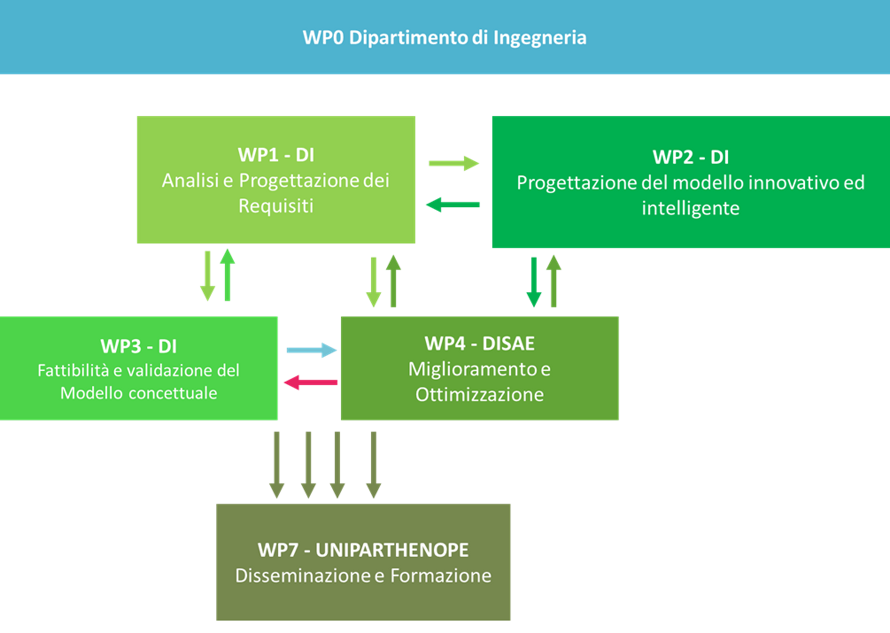

WP0 – Project Management (M1 – M18)
The purpose of WP0 is to provide the overall coordination and management of the project with the following objectives ensuring that the implementation of each WP is planned and executed effectively.
Task
• Task 0.1: Scientific and administrative coordination
• Task 0.2: Coordination, dissemination of results and communication
Deliverables
• Q0.1: Minute kick off meeting and minutes
• D0.2: Logo and website
• D0.3: Communication Materials
WP 1 - Requirements Analysis and Design (M1 - M4)
The objective of WP1 is twofold. Initially, an in-depth review of the scientific literature will be developed, aiming to identify any gaps. In particular, a comparative analysis of the evaluation models concerning sustainability and circularity in the reference production sectors, i.e. clothing, furniture and automation, will be conducted. On the basis of the results that emerged from the literature analysis, the specific needs in the aforementioned production sectors and new managerial tools will be identified. These tools will not only have to support the achievement of sustainability and circularity goals but also foster the acceptance and proactive involvement of the workforce in the new technological environment. Particular attention will be paid to the identification of new managerial tools aimed at enhancing the 360-degree skills and abilities of the workforce, integrating technologies capable of promoting continuous improvement of professional skills and environmental awareness. This phase will be crucial to guide the design of the model. The detailed identification of specific needs will make it possible to identify the most "critical" reference sector. For this sector, the management model will be defined, while identifying the key technologies for its implementation.
Task
• Task 1.1: Review of the scientific literature
• Task 1.2: Definition of the Management Model
• Task 1.3: Identification of technologies and design of the innovative and intelligent model
Deliverables
• D1.1: Scientific literature review report and comparative analysis
• D1.2: Specification of requirements for new managerial tools and technologies for model development
WP 2 – Design of the innovative and intelligent model (M5 – M9)
The main objective of WP2 is the implementation phase of the management model defined in the previous WP. This process involves translating the specific needs identified in WP1 into an operating system based on artificial intelligence (AI), the Internet of Things (IoT), life cycle analysis (LCA), and blockchain. An advanced AI-based system will be developed, which can interpret and respond to the specific needs of the identified production sector. This system will be designed to adapt to the complex and variable dynamics of the industrial contexts involved. The key technologies identified, including AI, IoT, LCA and blockchain, will be synergistically integrated to maximize their effectiveness. The goal will be to create an innovative and intelligent model capable of providing a complete and integrated view of production activities. The model will be able to adapt to the specific needs of the production sector of reference, while ensuring an efficient and innovative enhancement and management of resources.
The figure above represents the organizational structure and the interconnections between the various components of the system, highlighting (schematically) the flow of data and the decision-making process: from the collection and processing of data to their analysis and optimization. At the heart of this architecture is the "Data Processing Layer," which serves as the hub for collecting and processing data from different sources, including IoT infrastructure. This layer connects to the Analytics Engine and the Resource Optimization Engine to analyze data and optimize resource usage. The "Decision Support System" leverages these analyses to provide strategic recommendations. Data security and transactions are guaranteed by the "Blockchain & Security" component, while the "AI & Learning Models" allow the entire system to learn and improve over time.
Task
• Task 2.1: Definition of the Planning and Implementation Platform Architecture
• Task 2.2: User Interface Design
• Task 2.3: Identification of advanced AI algorithms for analysis and prediction
• Task 2.4: Design of the structure of the Model and components based on blockchain and IoT and AI
Deliverables
• D2.1: Model characterization report
WP 3 – Feasibility and validation of the conceptual model (M10 -M14)
WP3 represents a crucial phase of the project, dedicated to verifying the effectiveness of the model through its implementation in a simulated laboratory environment. This phase is divided into several activities aimed at evaluating the operation of the system in simulated but real conditions. An intensive phase of data collection will be launched, aimed at evaluating the behavior of the model in the different phases of the production cycle. Key indicators will be closely monitored to measure the impact of the system on operational performance and the effectiveness of the sustainable practices adopted. A detailed analysis of the model's effectiveness in real-world conditions in the pilot environment will be carried out. This assessment will include measuring performance in terms of sustainability, operational efficiency, and adherence to circularity targets, providing critical feedback for further refinement of the system.
Task
• Task 3.1: Implementation of the model powered by simulated data
• Task 3.2: Integration of AI algorithms for data analysis or final specifications for the definition of the Model
• Task 3.3: Development of the model structure and components based on blockchain, IoT and AI
• Task 3.4: Preliminary tests to verify the functionality of the model
Deliverables
• D3.1: Experimentation report and evaluation of the effectiveness of the model in a laboratory environment
WP 4 - Improvement and Optimization (M14 – M18)
WP4 is dedicated to refining the model based on the results obtained from the pilot test and optimizing it for large-scale deployment. This phase consists of activities aimed at strengthening the effectiveness of the system, improving its adaptability and ensuring a transition to sustainable and economically circular practices. A detailed analysis of the results obtained during the pilot test will be conducted, identifying strengths and possible areas for improvement. This phase will be essential to fully understand how the model works in the real production environment. Based on the results that emerged, the model will be subject to an optimization process aimed at improving its performance, reducing any inefficiencies and ensuring greater flexibility in adapting to the specific dynamics of the reference production sector. Necessary changes will be made to the model in order to make it suitable for large-scale deployment. You will define clear and detailed procedures for implementing the model. We will proceed with an assessment of the potential impact of the model on a large scale, measuring its contribution to sustainability, operational efficiency and the achievement of circular targets.
The aim is to provide companies with an advanced decision-making support tool to structure the path towards achieving sustainability and circularity objectives and to support institutional bodies in defining policies for the industrial development of territories, ensuring a positive impact on the communities in which the companies operate. The results will be presented in such a way as to provide recommendations o public authorities to inform their strategies and policies. This could include proposing to implement incentives for companies that adopt sustainable and economically circular practices, as well as the possible introduction of regulations to promote the wide adoption of the optimised model.
Task
• Task 4.1: Critical analysis of simulation results for large-scale development
• Task 4.2: Refine the model based on analysis feedback
• Task 4.3: Optimization of functionalities to expand the scope of decision support
• Task 4.4: Development of guidelines for large-scale implementation and policy recommendations
Deliverables
• D4.1: Reports on step-by-step procedures for implementing the optimized model
WP 5 - Dissemination and Training (Months 3-18)
WP5 plays a key role in promoting the success and adoption of the model developed during the project. This phase focuses on disseminating the knowledge gained and empowering stakeholders through training and strategic communication initiatives. Clear and engaging information materials, including brochures, presentations and dissemination documents, will be developed to effectively communicate the benefits and potential of the model. A dedicated website and possible online platforms will be created, providing a central point for access to information related to the project. These digital tools will be designed to facilitate understanding of the model, offer useful resources, and promote interaction with stakeholders. Dissemination events, such as webinars, workshops and conferences, will be organised to share the knowledge gained during the project. In addition, scientific publications will be produced to share the results, methodologies and innovations developed during the project.
Task
• Task 5.1: Creation of dissemination materials, technical documentation and website
• Task 5.2: Organization of workshops and seminars to involve stakeholders
• Task 5.3: Publication of results and best practices through conferences and specialized publications
Deliverables
• D5.1: Informational materials, including brochures, presentations and dissemination documents
• D5.2: Dedicated website and online platforms for access to project-related information
• D5.3: Organization of dissemination events, webinars and workshops
• D5.4: Scientific publications to share results, methodologies and innovations
PLA.I.A.
Driving Sustainable Innovation for Circular Industry Growth
Contacts
Principal Investigator: Fabio De Felice
Department of Engineering,
University of Naples Parthenope,
Centro Direzionale Isola C4, Napoli, Italy
fabio.defelice@uniparthenope.it